
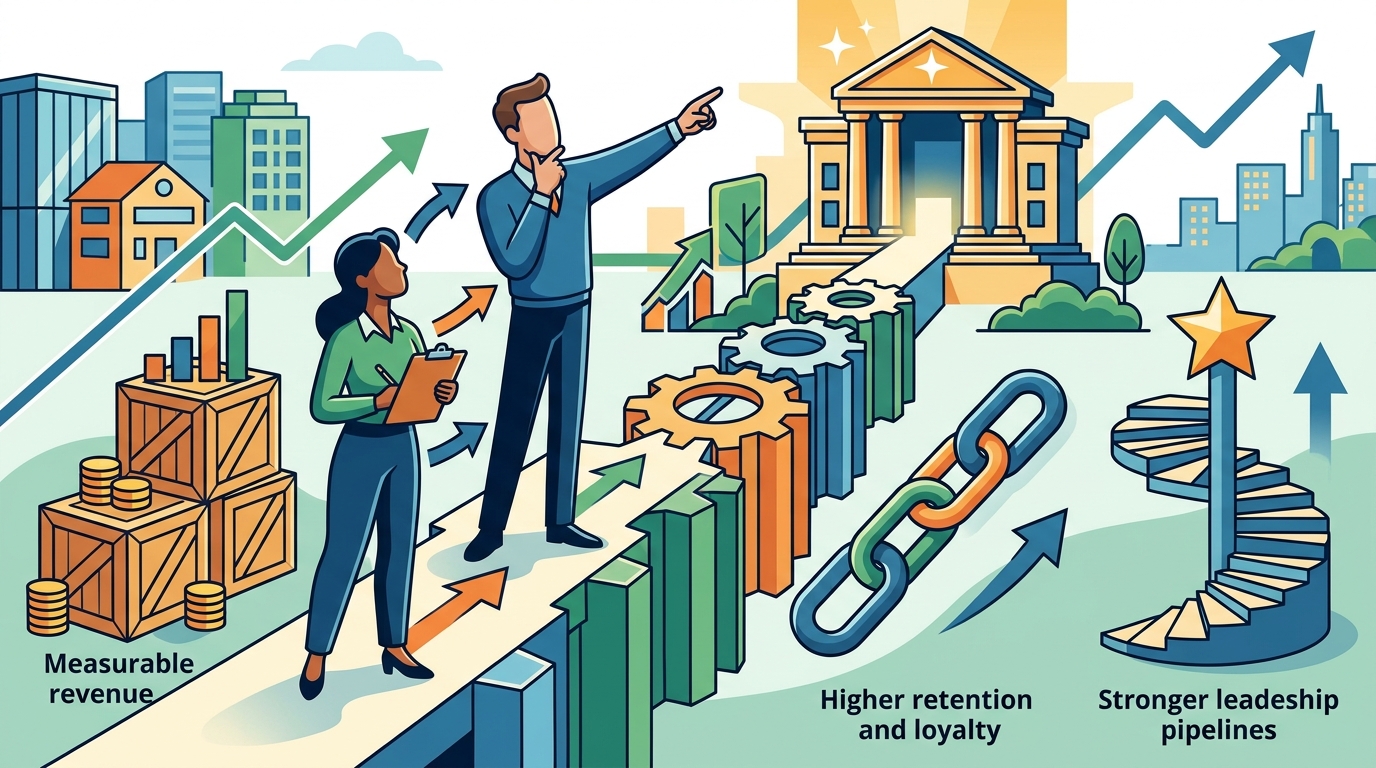
Every organization wants higher retention, stronger leadership pipelines, and measurable revenue growth. Yet one of the most proven strategies for achieving all three is still underused by mid-market companies: a structured mentorship program. A mentorship program is a formalized system that pairs experienced leaders with emerging talent to accelerate development, accountability, and performance. In this guide, we break down the research-backed benefits of mentorship, share the data Fortune 500 companies already act on, and show you how to build the kind of mentorship culture that people stay for.
1. Mentorship Dramatically Improves Employee Retention
Retention is the metric that keeps every CEO up at night. The data is clear: employees who have mentors stay longer. According to Mentorloop's 2026 research roundup, millennials with mentors are twice as likely to stay five or more years (68% vs. 32% without a mentor). Meanwhile, 94% of employees say they would remain at a company longer if it invested in their learning and development.
When Paychex launched a mentoring initiative for high-potential women, participant retention rates reached 94%, which was 14 percentage points above the company average. These are not marginal gains. They represent a direct reduction in the six-figure cost of replacing senior talent.
2. It Builds a Stronger Leadership Pipeline
A leadership pipeline is the internal system through which future managers and executives are identified, developed, and promoted. Organizations that mentor intentionally do not scramble to fill leadership vacancies because they have already invested in the next generation.
According to the International Coach Federation, 70% of individuals with mentors report improved work performance and leadership development. The Mentorship Masterclass that Jamie Mason Cohen delivers to organizations worldwide focuses on exactly this: giving leaders frameworks they can use immediately to develop the people below them into the leaders beside them.
Mentorship Accelerates Promotion Readiness
Employees who participate in mentoring programs hold higher positions at five times the rate of peers without mentors. This accelerated readiness reduces external hiring costs and preserves institutional knowledge.
Gen Z Demands It
83% of Gen Z workers believe having a workplace mentor is important to their career, yet only 52% report having one. Closing that gap is a competitive advantage for talent acquisition.
3. Mentorship Reduces the Isolation Tax of Leadership
The Isolation Tax is the hidden cost organizations pay when leaders feel alone at the top. It shows up as high turnover among managers, inconsistent decision-making, and burnout that quietly erodes culture. Jamie Mason Cohen, a Vistage Top Performer 2025 who has spoken in more than 30 countries, coined the term after spending 25 years proving in leadership rooms what he first observed behind the scenes at Saturday Night Live: connection is the prerequisite for high performance.
A mentorship culture addresses the Isolation Tax directly. When senior leaders mentor others, they build the trust-based relationships that keep them engaged, accountable, and supported. The benefit flows both directions: mentees gain guidance while mentors gain perspective and renewed purpose.
4. Fortune 500 Data: Mentorship and Profitability
The correlation between mentorship programs and business performance is striking. Below is a snapshot of the data from MentorcliQ's 2024 Mentoring Impact Report.
| Metric | Companies With Mentoring | Companies Without Mentoring |
|---|---|---|
| Fortune 500 adoption rate | 98% | 2% |
| Fortune 50 adoption rate | 100% | 0% |
| Median profits comparison | Over 2x higher | Baseline |
| Median YoY employee growth (2021) | +3% | -33% |
These numbers illustrate that mentorship is no longer optional for companies serious about sustainable growth. The median profit advantage alone makes the business case undeniable.
5. Mentorship Increases Engagement and Productivity
Employee engagement is the emotional and professional commitment a worker feels toward their organization. Gallup reported that only 31% of U.S. employees were engaged at work in 2024, and disengagement cost the global economy an estimated $438 billion in lost productivity.
Mentorship is one of the most effective countermeasures. According to research compiled by WomenTech Network, 67% of businesses reported increased productivity due to mentoring, and employees with mentors are twice as likely to report learning and growth opportunities at work. Jamie Mason Cohen's Saturday Night Leaders keynote teaches teams how to channel this kind of engagement under real deadline pressure, drawing on lessons from Lorne Michaels and the SNL production model.
Small Business Impact
The benefits are not limited to large enterprises. 92% of small business owners with mentors directly attribute the growth and survival of their businesses to those mentoring relationships.
6. Mentorship Advances Diversity, Equity, and Inclusion
Mentoring programs have been shown to boost minority representation at the management level from 9% to 24%, and promotion and retention rates for minorities and women from 15% to 38% compared to non-mentored employees. Organizations that embed mentorship into their DEI strategy create more equitable paths to leadership and a stronger sense of belonging across the workforce.
When leaders learn to mentor across differences, they build the inclusive culture that top talent increasingly demands. Nearly 80% of employees say they want to work for a company that values DEI, according to a CNBC/SurveyMonkey study. Structured mentorship is how you move from intention to action. Explore Jamie's approach to building signature leadership cultures that reflect these values.
Key Takeaways
- 98% of Fortune 500 companies now have mentorship programs, and those with programs report over 2x higher median profits.
- Millennials with mentors are twice as likely to stay five or more years, making mentorship a top retention strategy.
- The Isolation Tax of Leadership is the hidden cost of leaders feeling alone; mentorship is its most effective remedy.
- 67% of businesses report increased productivity when mentoring programs are in place.
- Mentoring boosts minority management representation from 9% to 24%.
- 92% of small business owners with mentors attribute their business survival to those relationships.
- Building a mentorship culture requires intentional frameworks, not just good intentions.
Frequently Asked Questions
What is a mentorship program?
A mentorship program is a structured initiative that connects experienced professionals with less experienced colleagues for the purpose of knowledge transfer, skill development, and career advancement.
How does mentorship directly impact business growth?
Mentorship improves retention, accelerates leadership development, increases productivity, and strengthens culture. Fortune 500 companies with mentoring programs report over 2x higher median profits than those without.
What is the Isolation Tax of Leadership?
The Isolation Tax is a concept developed by Jamie Mason Cohen describing the hidden costs organizations pay when leaders feel alone. These costs include turnover, poor decision-making, and burnout that erodes performance.
How long does it take to see results from a mentorship program?
Many organizations see measurable improvements in engagement and retention within six to twelve months of launching a structured program. Quick wins like improved manager communication often appear even sooner.
Are mentorship programs only for large corporations?
No. In fact, 92% of small business owners with mentors say those relationships directly contributed to their business growth and survival. Mentorship scales to any organization size.
What makes Jamie Mason Cohen's mentorship keynotes different?
Jamie delivers highly customized, interactive experiences grounded in his behind-the-scenes work at Saturday Night Live and 25 years of leadership coaching. His programs carry a 4.5+/5 average rating and 95%+ recommendation scores from audiences in over 30 countries.
How do I start building a mentorship culture?
Start by identifying your organization's biggest leadership gaps, then pair senior leaders with emerging talent using clear goals and accountability structures. Programs like Jamie's Mentorship Masterclass provide the frameworks to get started immediately.
Build Your Mentorship Culture Today
If you are ready to reduce the Isolation Tax, improve retention, and build the kind of culture people stay for, the next step is simple. Book Jamie Mason Cohen for your next leadership retreat, conference, or Vistage session and give your leaders the mentorship frameworks that drive real, measurable business growth.