
Leadership Development Tools and Frameworks That Help Leaders Succeed
Every organization wants stronger leaders, but few invest in the right tools and frameworks to build them. With global employee engagement dropping to just 21% in 2024 and manager engagement falling from 30% to 27%, the cost of underdeveloped leadership has never been higher. A leadership development framework is a structured approach that outlines key skills, behaviors, and processes to develop effective leaders within an organization. This guide breaks down the most impactful tools, frameworks, and mentorship strategies that help leaders communicate under pressure, retain top talent, and drive measurable business growth.
Why Leadership Development Matters Now More Than Ever
The data paints an urgent picture. According to Gallup's 2026 State of the Global Workplace report, the largest single-year drop in manager engagement occurred between 2024 and 2025, declining five points from 27% to 22%. This is not an abstract number. Managers account for 70% of the variance in team-level engagement, meaning when managers disengage, entire teams follow.
The economic toll is staggering. Gallup estimates that disengagement cost the world economy more than $10 trillion in lost productivity in 2024 alone. Organizations that ignore leadership development are not just losing talent; they are hemorrhaging revenue.
Core Leadership Development Frameworks
Competency-Based Models
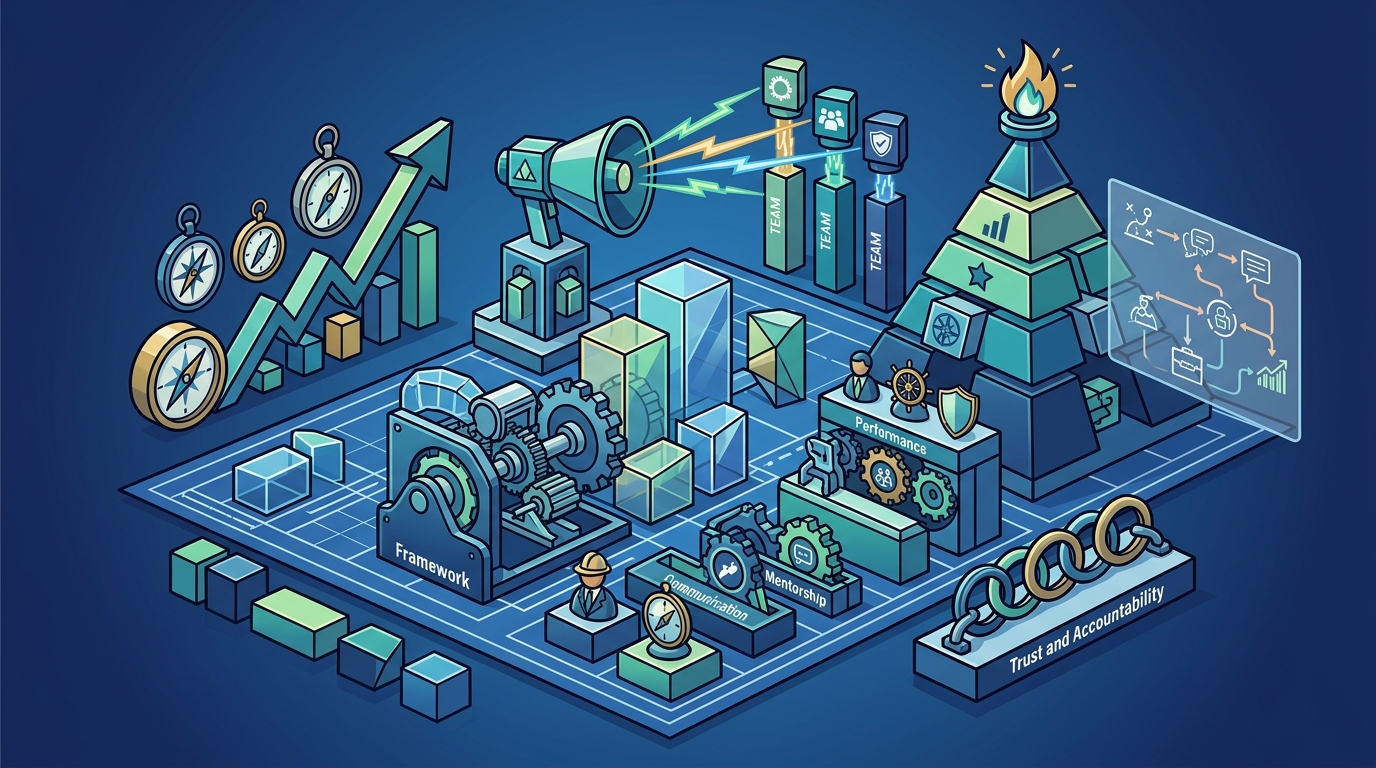
A leadership competency model is a defined set of core skills, such as strategic thinking, communication, conflict resolution, and change management, mapped to specific leadership roles. Organizations like IBM align their frameworks with decision-making, collaboration, and strategic thinking to tie leadership growth directly to business objectives.
Adaptive Leadership Frameworks
According to SHRM, organizations are shifting from traditional leadership models to adaptive frameworks that emphasize learning, experimentation, and collaboration. In a volatile business landscape, adaptive leaders thrive because they treat uncertainty as an input rather than an obstacle.
The "11:30" Framework
One of the most practical leadership frameworks comes from an unlikely source: Saturday Night Live. Jamie Mason Cohen's Saturday Night Leaders keynote draws on the philosophy of SNL creator Lorne Michaels, who famously said the show was not ready because it was finished but because it was 11:30 on Saturday night. This framework helps teams identify their own "11:30" moment and build the discipline to deliver under pressure, every single time.
Building a Mentorship Culture That Drives Retention
Traditional classroom-based leadership development is giving way to more personalized, collaborative approaches. Mentorship is at the center of this shift. A mentorship culture is an organizational environment where experienced leaders intentionally guide emerging talent through structured relationships built on trust, accountability, and shared learning.
Research consistently shows that when managers receive role-specific training and ongoing mentorship support, their reported well-being jumps significantly. Jamie Mason Cohen's Mentorship Masterclass provides frameworks, stories, and tools leaders can use immediately to reduce turnover, improve accountability, and create the kind of culture people stay for. His programs have delivered results for organizations including Sun Life Financial, Novo Nordisk, and Sanofi, with a 4.5+/5 average rating and 95%+ recommendation scores.
The difference between training and mentorship is sustainability. Training sparks change. Ongoing mentorship sustains it. Programs that combine both can improve performance by up to 20% and dramatically reduce the revolving door of talent.
Assessment Tools Every Leader Should Use
You cannot develop what you do not measure. The most effective leadership programs combine diagnostic tools with personalized coaching. An assessment tool is an instrument, such as a 360-degree feedback survey or psychometric test, designed to measure current leadership capabilities and identify development gaps.
Key assessment tools include:
- 360-Degree Feedback: Gathers input from peers, direct reports, and supervisors to create a holistic view of leadership effectiveness.
- The Leadership Circle Profile: A data-informed 360 that distinguishes between creative and reactive leadership tendencies. Jamie Mason Cohen is a certified Leadership Coach with The Leadership Circle, combining this assessment with his signature handwriting analysis to reveal strengths and blind spots leaders often miss.
- Psychometric Testing: Tools like DISC and Myers-Briggs help leaders understand communication styles and team dynamics.
- AI-Powered Platforms: Modern platforms integrate artificial intelligence to personalize learning paths and track leadership growth over time.
The Isolation Tax: The Hidden Cost Nobody Tracks
There are costs no one tracks on a spreadsheet. High turnover, underperforming managers, and leaders who feel alone at the top are all symptoms of what Jamie Mason Cohen calls the Isolation Tax of Leadership. The Isolation Tax is the cumulative organizational cost, measured in turnover, burnout, and poor decision-making, that results from leaders lacking meaningful connection and support.
Gallup's findings reinforce this concept. Managers are increasingly only as engaged as the individual contributors they lead, erasing the "engagement premium" that once set them apart. When leaders feel isolated, they make worse decisions, communicate less effectively, and ultimately leave, taking institutional knowledge with them.
Cohen's approach, developed over 25 years and informed by his time behind the scenes at Saturday Night Live, directly addresses this gap. His keynotes in more than 30 countries help organizations replace isolation with intentional mentorship, turning lonely leadership into connected, high-performing teams.
Comparing Popular Leadership Development Approaches
| Approach | Best For | Format | Measurability | Retention Impact |
|---|---|---|---|---|
| Mentorship Culture Programs | Reducing isolation, building trust | Keynotes, workshops, ongoing coaching | High (engagement + retention metrics) | Very High |
| 360-Degree Feedback | Self-awareness, blind spot identification | Survey-based assessment | High (quantitative scores) | Moderate |
| Executive Coaching (1:1) | Senior leaders, C-suite | Private sessions | Moderate (subjective outcomes) | High |
| Online Learning Platforms | Scalable skill-building | Self-paced digital courses | Moderate (completion rates) | Low to Moderate |
| Peer Advisory Groups (e.g., Vistage) | CEO-level decision support | Monthly group meetings | High (business outcome tracking) | High |
The most effective organizations combine multiple approaches. Peer advisory groups like Vistage, where Jamie Mason Cohen is recognized as a 2025 Top Performer, pair well with mentorship keynotes and ongoing coaching to create sustained leadership growth.
Key Takeaways
- Manager engagement has dropped to historic lows, making leadership development an urgent business priority.
- A leadership development framework should align leadership competencies with measurable business outcomes.
- Mentorship cultures outperform one-time training events because they sustain behavioral change over time.
- Assessment tools like 360-degree feedback and The Leadership Circle Profile reveal blind spots that self-reflection alone cannot.
- The Isolation Tax of Leadership is a hidden cost that drives turnover, burnout, and poor decision-making at the top.
- Adaptive leadership frameworks help leaders thrive in volatile, uncertain, and complex environments.
- Combining peer advisory groups, mentorship keynotes, and coaching creates the most comprehensive development strategy.
Frequently Asked Questions
What is a leadership development framework?
A leadership development framework is a structured approach that outlines key skills, behaviors, and processes to develop effective leaders. It typically includes leadership competencies, training programs, assessment tools, and feedback mechanisms designed to align leadership capabilities with organizational goals.
What tools are used for leadership development?
Common tools include 360-degree feedback surveys, psychometric assessments (DISC, Myers-Briggs), The Leadership Circle Profile, AI-powered learning platforms, and mentorship programs. The best strategies combine diagnostic assessment with ongoing coaching and real-world application.
How does mentorship improve leadership performance?
Mentorship provides leaders with ongoing support, accountability, and perspective that one-time training cannot deliver. Organizations that build mentorship cultures see improvements in retention, engagement, and decision-making quality. Programs like Jamie Mason Cohen's Mentorship Masterclass help leaders implement these cultures immediately.
What is the Isolation Tax of Leadership?
The Isolation Tax is a term coined by Jamie Mason Cohen to describe the hidden organizational costs that arise when leaders feel alone at the top. These costs manifest as high turnover, underperforming managers, burnout, and poor communication, none of which appear on a traditional balance sheet.
Why is manager engagement declining?
According to Gallup, managers face conflicting demands from executives and employees, navigate team restructures and tighter budgets, and contend with the accelerating impact of AI, often without adequate tools or support. The engagement premium that managers once enjoyed has essentially vanished.
How can organizations measure leadership development ROI?
Organizations can track leadership development ROI through engagement scores, retention rates, 360-degree feedback improvements, productivity metrics, and direct business outcomes like revenue growth. In 2025, more companies are adopting data-driven methods to prove the effectiveness of their leadership programs.
What makes Jamie Mason Cohen's approach different?
Jamie Mason Cohen combines 25 years of leadership expertise, lessons from working behind the scenes at Saturday Night Live, and certification with The Leadership Circle to deliver highly customized, interactive keynotes. His programs focus on building mentorship cultures that reduce isolation, improve accountability, and drive measurable performance gains across organizations in more than 30 countries.
Build the Leadership Culture Your Organization Deserves
The frameworks and tools outlined in this guide are only as effective as the action you take next. If your organization is ready to reduce the Isolation Tax, build a mentorship culture, and develop leaders who perform under pressure, book a discovery call with Jamie Mason Cohen to explore how his programs can drive measurable results for your team.