
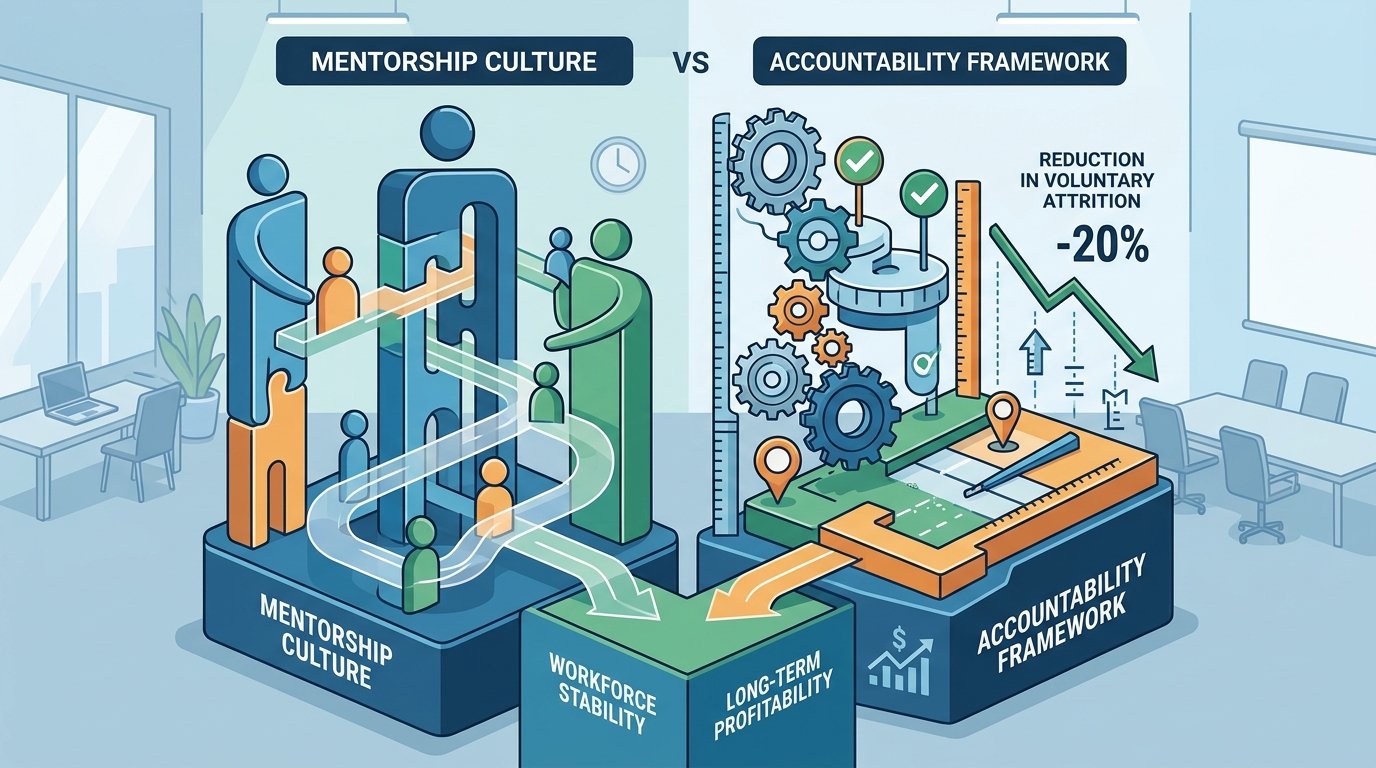
Organizations that prioritize structured mentorship and clear operational expectations consistently outperform peers in workforce stability. Recent workplace analytics indicate that companies with robust accountability frameworks experience a twenty percent reduction in voluntary attrition within eighteen months. This data shows that intentional cultural design directly impacts retention metrics and long term profitability. Leaders must replace reactive hiring cycles with proactive retention strategies. Establishing clear behavioral standards and measurable performance benchmarks creates a predictable environment where employees understand their exact responsibilities. When teams operate with transparent expectations, discretionary effort increases and operational friction decreases significantly.
Defining Organizational Culture and Retention Mechanics
Organizational culture is the shared set of values, behaviors, and operational norms that dictate how teams execute daily tasks. This invisible architecture determines whether employees feel supported or isolated. Companies that fail to document their cultural expectations experience higher conflict rates and slower project delivery. Leadership must explicitly communicate core values through recurring workshops and documented playbooks. When cultural alignment matches individual professional goals, retention rates improve naturally. Leaders who invest in structured onboarding and continuous feedback loops report stronger team cohesion. Establishing a mentorship program provides junior staff with direct access to institutional knowledge. This knowledge transfer reduces costly trial and error cycles. Teams that operate with documented cultural standards demonstrate faster decision making and fewer compliance violations. Leadership accountability frameworks require executives to model the exact behaviors they expect from direct reports. When managers consistently demonstrate transparency and follow through on commitments, trust compounds across departments. Organizations that prioritize psychological safety report higher innovation output and lower burnout rates.
Diagnosing Turnover Drivers and Cultural Friction
Employee turnover is the voluntary or involuntary separation of staff members from an organization, often signaling deeper systemic issues. High attrition rarely stems from compensation alone. Research shows that unclear career progression and inconsistent management practices drive qualified professionals toward competitors. Leaders must conduct quarterly cultural audits to identify friction points before they trigger mass resignations. Common friction points include ambiguous role definitions, inconsistent performance reviews, and lack of recognition programs. Addressing these issues requires direct conversation and structural adjustment. Companies that implement stay interviews discover hidden dissatisfaction before exit interviews become necessary. Regular pulse surveys provide real time data on team sentiment and operational bottlenecks. When leadership acts on survey feedback, employee engagement scores typically rise by fifteen percent. Organizations that fail to address cultural friction experience compounding recruitment costs and lost institutional memory. Implementing a structured feedback mechanism allows teams to voice concerns without fear of retaliation. This transparency builds trust and accelerates problem resolution. Leaders who prioritize open communication channels create environments where accountability becomes a shared responsibility rather than a top down mandate.
Implementing Leadership Mentorship and Development
Mentorship is a structured developmental relationship where experienced professionals guide less experienced colleagues toward specific career milestones. This practice directly reduces turnover by providing clear pathways for advancement. Organizations that pair high potential staff with senior executives report faster skill acquisition and higher retention rates. Executive sponsorship programs ensure that emerging leaders receive visibility and strategic guidance. Companies that invest in internal mobility programs fill critical roles faster and reduce external hiring expenses. Leadership development requires consistent investment in training resources and measurable progress tracking. Teams that participate in structured coaching programs demonstrate improved conflict resolution and project delivery speed. Organizations that prioritize internal promotion pipelines maintain cultural continuity and reduce onboarding costs. Leaders must allocate dedicated time for mentorship activities to ensure consistent participation. When executives model continuous learning, staff members mirror that commitment. Companies that integrate mentorship into performance reviews create accountability loops that reinforce development goals. This systematic approach transforms casual advice into measurable career progression. Organizations that track mentorship outcomes report higher employee satisfaction and stronger succession planning readiness.
The Founder Bottleneck Checklist
Founder bottleneck syndrome occurs when a single executive retains excessive decision making authority, creating operational paralysis and stifling team autonomy. This condition directly increases turnover as capable staff members grow frustrated by restricted growth opportunities. Leaders must systematically delegate authority to empower middle management and accelerate project velocity. Organizations that implement clear delegation matrices experience faster execution and higher employee ownership. Founders who transition from operator to strategist unlock scalable growth and reduce personal burnout. Implementing a founder bottleneck checklist ensures that critical decisions are distributed across qualified team members. This distribution prevents single points of failure and builds organizational resilience. Companies that document decision rights create clearer accountability boundaries and reduce meeting fatigue. Leaders who trust their teams with strategic input report higher innovation rates and stronger retention. Organizations that regularly audit delegation practices maintain agile operations and prevent executive overload. This systematic approach transforms founder dependency into distributed leadership capacity.
Measuring Cultural ROI and Operational Health
Cultural return on investment is the measurable financial impact of retention strategies, accountability frameworks, and leadership development programs. Organizations that track cultural metrics alongside financial KPIs gain actionable insights into operational efficiency. Key performance indicators include voluntary turnover rates, internal promotion percentages, employee engagement scores, and project delivery timelines. Companies that integrate cultural dashboards into quarterly business reviews align leadership priorities with workforce stability. Tracking these metrics allows executives to adjust strategies before attrition spikes. Organizations that benchmark their cultural health against industry standards identify competitive advantages and operational gaps. Leaders who publish cultural reports demonstrate transparency and reinforce accountability expectations. Companies that reward managers for retention metrics create financial incentives that align with long term stability. This alignment ensures that cultural initiatives receive consistent funding and executive support. Organizations that measure cultural ROI consistently report higher profitability and stronger market positioning. Leaders who prioritize data driven cultural adjustments build resilient organizations capable of weathering economic shifts.
| Cultural Strategy | Implementation Complexity | Expected Retention Impact | Primary Accountability Mechanism |
|---|---|---|---|
| Structured Mentorship Programs | Moderate | High | Quarterly Progress Reviews |
| Founder Delegation Matrices | High | Very High | Decision Rights Documentation |
| Pulse Survey Feedback Loops | Low | Moderate | Real Time Sentiment Tracking |
| Internal Mobility Pipelines | Moderate | High | Succession Planning Audits |
| Executive Accountability Frameworks | High | Very High | 360 Degree Performance Reviews |
Key Takeaways
- Organizations with documented cultural frameworks experience a twenty percent reduction in voluntary attrition within eighteen months.
- Structured mentorship programs directly correlate with higher internal promotion rates and reduced external hiring costs.
- Founder bottleneck syndrome creates operational paralysis and accelerates turnover among high performing staff members.
- Quarterly cultural audits identify friction points before they trigger mass resignations and project delays.
- Companies that track cultural ROI alongside financial KPIs consistently outperform industry retention benchmarks.
- Leadership accountability frameworks require executives to model transparency and follow through on stated commitments.
- Organizations that implement stay interviews discover hidden dissatisfaction and adjust retention strategies proactively.
Frequently Asked Questions
How do you measure cultural health in a growing organization?
Cultural health is measured through quarterly pulse surveys, voluntary turnover rates, internal promotion percentages, and employee engagement scores. Leaders combine these metrics to identify friction points and adjust retention strategies accordingly.
What is the most effective way to reduce founder bottleneck syndrome?
The most effective method involves implementing a founder bottleneck checklist that documents decision rights and systematically delegates authority to qualified middle managers. This distribution prevents operational paralysis and accelerates team autonomy.
How often should leadership conduct cultural audits?
Leadership should conduct cultural audits quarterly to identify emerging friction points, track retention metrics, and adjust accountability frameworks before attrition spikes. Regular audits ensure continuous alignment between stated values and daily operations.
Can mentorship programs actually impact executive retention rates?
Yes, structured mentorship programs directly impact executive retention by providing clear career progression pathways and reducing isolation among high performing staff. Organizations that track mentorship outcomes report higher employee satisfaction and stronger succession planning readiness.
What metrics should boards prioritize when evaluating cultural ROI?
Boards should prioritize voluntary turnover rates, internal promotion percentages, project delivery timelines, and employee engagement scores. These indicators provide actionable insights into operational efficiency and long term workforce stability.
How do stay interviews differ from traditional exit interviews?
Stay interviews are proactive conversations conducted with current employees to identify hidden dissatisfaction and adjust retention strategies before resignation notices are submitted. This approach builds trust and accelerates problem resolution.
What role does psychological safety play in accountability frameworks?
Psychological safety is the shared belief that team members can take interpersonal risks without fear of punishment or humiliation. This environment encourages transparency, accelerates conflict resolution, and strengthens accountability expectations across all departments.
Next Steps for Your Organization
Building a culture that reduces turnover and improves accountability requires intentional design, consistent leadership modeling, and measurable tracking. Organizations that implement structured mentorship programs, founder delegation matrices, and quarterly cultural audits consistently outperform industry retention benchmarks. Leaders who prioritize transparency and data driven adjustments build resilient teams capable of scaling operations without sacrificing stability. Schedule a consultation to evaluate your current cultural framework and implement targeted retention strategies. Visit the Meet Jamie page to review executive mentorship credentials. Review the Client Results section to see documented retention improvements. Explore the Speaking portfolio for workshop formats. Review the FAQ page for implementation details. Access the Founder Bottleneck Checklist to begin delegation audits. Book your team through the Event Planners portal to schedule a cultural transformation workshop.