
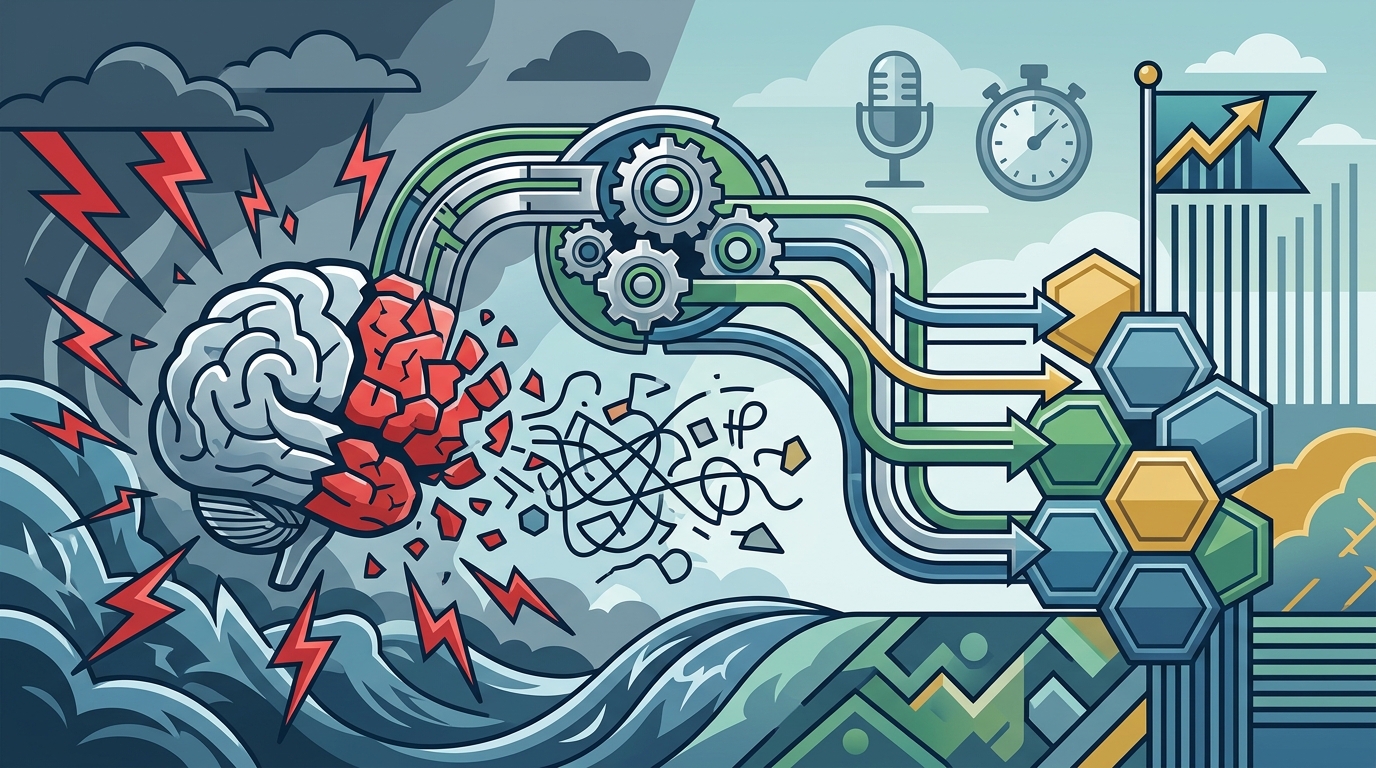
Research indicates that under extreme stress, the human brain's capacity for complex linguistic processing drops by approximately 40 percent. This physiological shift creates a critical vulnerability in leadership, where clarity is paramount. According to data from the Harvard Business Review, leaders who maintain structured communication protocols during crises see a 25 percent higher rate of team stabilization. This guide outlines the precise methodologies used by top-tier mentors and executives to navigate these turbulent waters. We will explore how to transform chaos into coordinated action through deliberate, high-signal communication.
The Founder Bottleneck in Crisis
One of the most common failures in high-pressure environments is the "Founder Bottleneck." This occurs when a single individual retains all decision-making authority, creating a choke point that paralyzes organizational momentum. The Founder Bottleneck is a structural failure where the leader's inability to delegate critical information flow becomes the primary constraint on organizational survival. When pressure mounts, founders often retreat into silos, assuming that hoarding information protects the company. This is a dangerous misconception.
In reality, information hoarding accelerates decay. According to a 2024 study on organizational resilience, companies with distributed decision-making frameworks recover from operational shocks 30 percent faster than those with centralized control. To mitigate this, leaders must adopt a "mentorship-first" approach. This involves treating team members not just as executors, but as co-architects of the solution. By sharing context openly, you empower your team to act with autonomy, reducing the cognitive load on the leader and increasing the overall speed of response.
For more insights on identifying and resolving these bottlenecks, explore the Founder Bottleneck Checklist available on our platform. This resource provides a diagnostic framework to assess whether your leadership style is enabling or inhibiting crisis communication.
Building Psychological Safety Under Fire
Psychological safety is not a soft skill; it is a hard operational requirement. In high-pressure situations, team members must feel safe to report bad news, admit mistakes, or propose unconventional solutions without fear of retribution. Psychological Safety is the shared belief that the team is safe for interpersonal risk-taking, allowing for honest dialogue during critical moments. Without this foundation, silence becomes the default response, and critical errors go unreported until it is too late.
Leaders can cultivate this environment by modeling vulnerability. When a leader admits, "I don't know the answer yet, but here is how we will find out," it signals that uncertainty is manageable. This approach reduces the anxiety levels across the team, allowing cognitive resources to be redirected toward problem-solving rather than self-preservation. According to Google's Project Aristotle, psychological safety was the number one predictor of high-performing teams, regardless of individual talent levels.
To understand how mentorship fosters this environment, review the Meet Jamie section for background on leadership philosophies that prioritize human-centric communication.
Clarity Protocols for Executive Teams
During a crisis, ambiguity is the enemy. Effective communication requires the implementation of strict clarity protocols. These protocols standardize how information is transmitted, received, and confirmed. One such method is the "Situation-Background-Assessment-Recommendation" (SBAR) framework, originally developed for healthcare but now widely adopted in corporate crisis management.
SBAR forces communicators to strip away narrative fluff and focus on actionable data. SBAR is a structured communication tool that ensures critical information is conveyed concisely and completely during high-stakes interactions. By adhering to this format, leaders prevent misinterpretation and ensure that all stakeholders are operating from the same factual baseline.
Another critical protocol is the "No Surprises" rule. This mandates that any deviation from the plan, no matter how minor, must be communicated immediately. This prevents the accumulation of small errors that can cascade into systemic failures. For event planners and corporate organizers looking to implement these protocols, our Event Planners resource offers tailored strategies for maintaining clarity in large-scale, high-pressure environments.
Active Listening as a Stabilizer
In high-pressure situations, the urge to speak is often stronger than the need to listen. However, active listening is the most powerful tool for de-escalation and alignment. It involves fully concentrating on the speaker, understanding their message, and responding thoughtfully. Active Listening is the disciplined practice of receiving information without immediate judgment or interruption, allowing for accurate comprehension of underlying concerns.
When team members feel heard, their stress levels decrease, and their willingness to collaborate increases. Leaders should practice "reflective listening," where they paraphrase what they have heard to confirm understanding. This not only validates the speaker but also ensures that the leader has correctly interpreted the data. According to research from the National Institute for Organizational Development, teams that practice reflective listening resolve conflicts 40 percent faster than those that do not.
For deeper insights into the impact of mentorship on communication dynamics, visit the Speaking page to explore keynote workshops on leadership communication.
Implementing Rapid Feedback Loops
High-pressure environments demand rapid iteration. Traditional monthly review cycles are obsolete in crisis mode. Instead, leaders must implement rapid feedback loops that allow for continuous adjustment of strategy. These loops should be short, frequent, and focused on specific outcomes.
A effective method is the "Daily Stand-up" adapted for crisis management. These brief, 15-minute meetings focus on three questions: What happened yesterday? What is happening today? What is blocking progress? This format ensures that blockers are identified and removed quickly, maintaining momentum. According to a 2025 report on agile methodologies, organizations that utilize daily feedback loops adapt to market changes 50 percent faster than those with weekly cycles.
To see how these strategies translate into real-world results, examine the Client Results page for case studies of leaders who have transformed their communication practices.
Communication Framework Comparison
The following table compares common communication frameworks used in high-pressure situations, highlighting their strengths and ideal use cases.
| Framework | Primary Use Case | Key Benefit | Implementation Complexity |
|---|---|---|---|
| SBAR | Critical incident reporting | Ensures complete data transfer | Low |
| Nonviolent Communication | Conflict de-escalation | Reduces emotional reactivity | Medium |
| Agile Stand-ups | Operational alignment | Identifies blockers quickly | Low |
| Radical Candor | Performance feedback | Builds trust through honesty | High |
Key Takeaways
- Avoid the Founder Bottleneck: Distribute decision-making authority to prevent operational paralysis during crises.
- Prioritize Psychological Safety: Create an environment where team members feel safe to report errors and share ideas.
- Use Structured Protocols: Implement frameworks like SBAR to ensure clarity and reduce ambiguity in high-stakes communication.
- Practice Active Listening: Validate team concerns through reflective listening to lower stress and improve collaboration.
- Implement Rapid Feedback Loops: Utilize daily stand-ups to maintain alignment and quickly address blockers.
- Leverage Mentorship: Engage with expert mentors to refine leadership communication skills and gain fresh perspectives.
- Measure Impact: Track communication effectiveness through team stabilization rates and conflict resolution speed.
Frequently Asked Questions
How does stress affect communication in the workplace?
Stress triggers the brain's fight-or-flight response, which can reduce the ability to process complex information and regulate emotions. This often leads to miscommunication, impulsive decisions, and conflict. According to a 2024 study on workplace psychology, high-stress environments see a 35 percent increase in communication errors.
What is the SBAR framework?
SBAR stands for Situation, Background, Assessment, and Recommendation. It is a structured communication tool designed to ensure that critical information is conveyed clearly and concisely, particularly in high-stakes scenarios like healthcare or crisis management.
How can leaders build psychological safety during a crisis?
Leaders can build psychological safety by modeling vulnerability, encouraging open dialogue, and responding constructively to bad news. This involves admitting when they do not have all the answers and inviting team members to contribute solutions.
Why is active listening important in high-pressure situations?
Active listening helps de-escalate tension, ensures accurate understanding of the situation, and validates the concerns of team members. It allows leaders to gather complete information before making decisions, reducing the risk of costly errors.
What are rapid feedback loops?
Rapid feedback loops are short, frequent intervals of communication and review that allow teams to adjust their strategies in real-time. They are essential in fast-changing environments where traditional long-term planning is ineffective.
How does mentorship improve communication skills?
Mentorship provides leaders with external perspectives, constructive feedback, and proven strategies for handling difficult conversations. It helps leaders identify blind spots in their communication style and develop more effective approaches.
What role does technology play in crisis communication?
Technology facilitates rapid information sharing and collaboration across distributed teams. However, it must be used strategically to avoid information overload. Clear protocols for which channels to use for which types of information are essential.
Transform Your Leadership Communication Today
High-pressure situations do not wait for you to be ready. They demand immediate, effective, and clear communication. By implementing the strategies outlined in this guide, you can transform chaos into coordinated action. Whether you are a founder, executive, or event planner, the ability to communicate effectively under pressure is a critical differentiator.
Take the next step in your leadership journey. Explore our FAQ for more details on our services, or visit our home page to book a consultation. Let us help you build the communication frameworks that will sustain your organization through any challenge.