
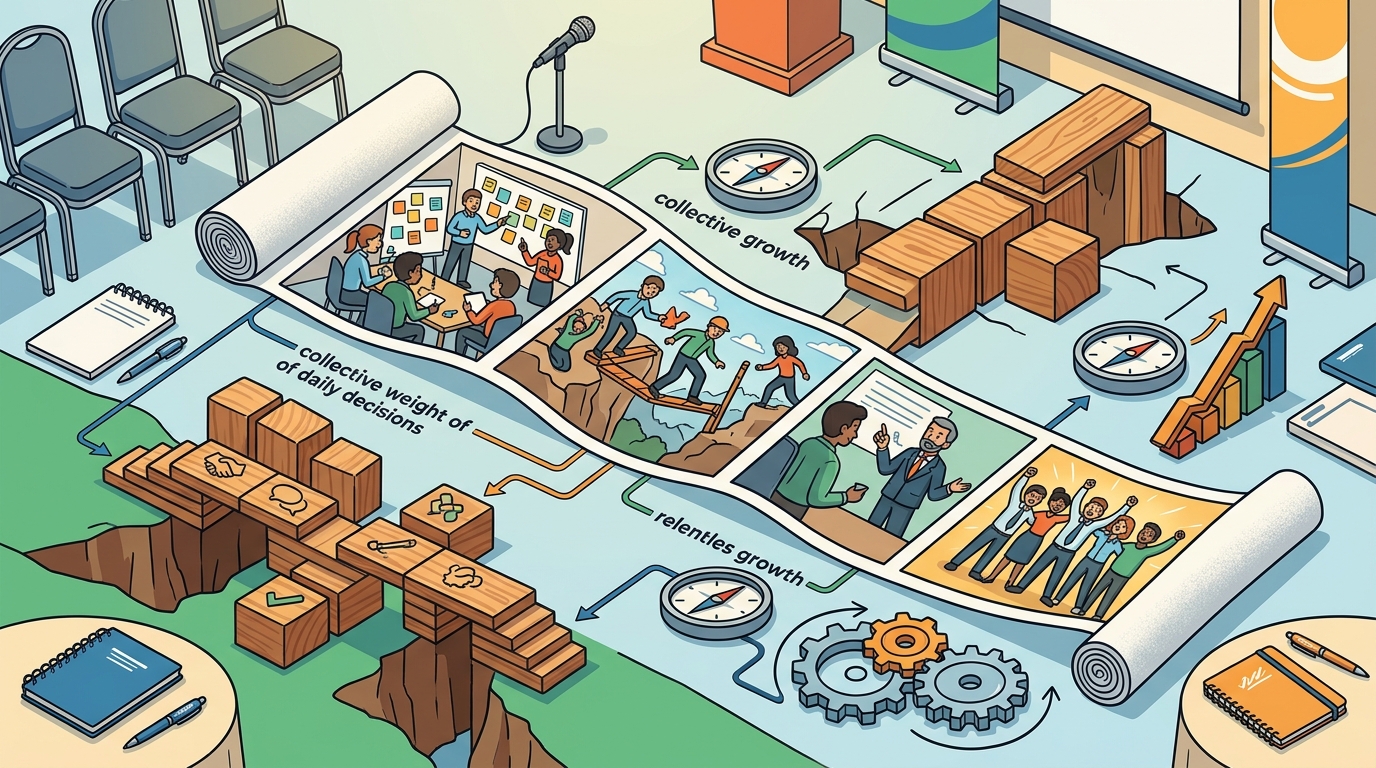
Leadership is rarely defined by a single moment of triumph. It is built through the cumulative weight of daily decisions, failures, and the relentless pursuit of collective growth. According to recent organizational behavior studies, companies with high-trust cultures outperform their peers by 50% in employee engagement and retention metrics. This statistic highlights a critical reality: the stories leaders tell and the experiences they share are not just motivational fluff. They are the structural beams holding up a resilient workforce. When business leaders open themselves to vulnerability and mentorship, they create a ripple effect that transforms individual potential into organizational power. (The Mentor Effect Jamie)
The Founder Bottleneck: Letting Go to Grow
One of the most pervasive challenges in business is the founder who remains the operating system. This phenomenon occurs when a leader cannot delegate core responsibilities, creating a single point of failure. The Founder Bottleneck Checklist provides a diagnostic framework to identify these constraints. When a leader refuses to step back, the team stagnates. They become order-takers rather than innovators.
Consider the story of a mid-sized tech firm where the CEO insisted on approving every email. The result was a three-month delay in product launches and a 40% turnover rate among senior developers. The team felt unheard and undervalued. The leader believed they were protecting the company. In reality, they were suffocating it.
Breaking this cycle requires intentional effort. Leaders must shift from being the hero of every story to being the architect of the environment. This shift allows team members to own their narratives. It fosters accountability and accelerates decision-making. The goal is not to do less work but to enable others to do more. This transition is often the first step toward building a truly scalable organization.
Mentorship as a Catalyst for Clarity
Mentorship is the deliberate transfer of wisdom from one generation of leaders to the next. It is not merely advice giving. It is a structured relationship focused on growth, accountability, and perspective. The Mentor Effect demonstrates how guided reflection can unlock potential that self-study cannot reach. When leaders engage with mentors, they gain access to blind spots they cannot see themselves.
Take the example of a startup founder who struggled with scaling their sales team. Through a structured mentorship program, they learned to distinguish between activity and productivity. The mentor challenged their assumptions about hiring. The founder realized they were hiring for skills rather than cultural fit. This insight changed the trajectory of the company. Revenue grew by 25% in the following quarter as team cohesion improved.
Effective mentorship requires vulnerability. Leaders must admit what they do not know. They must be willing to be uncomfortable. This openness signals to the team that growth is a continuous journey. It normalizes the learning process. When leaders model this behavior, they create a culture where asking for help is seen as a strength, not a weakness. This cultural shift is essential for building stronger, more adaptable teams.
Navigating Failure with Grace
Failure is an inevitable part of business. The difference between successful and struggling organizations is how they respond to it. Leaders who blame others create fear. Leaders who take responsibility create trust. The way a leader handles a crisis sets the tone for the entire organization. If they panic, the team panics. If they remain calm and analytical, the team finds solutions.
Consider a retail chain that faced a significant supply chain disruption. The leadership team could have blamed external vendors. Instead, they gathered the team to brainstorm internal workarounds. They acknowledged the mistake in their forecasting. They invited input from warehouse staff who saw the issues first. This collaborative approach turned a potential disaster into a case study in resilience. The team felt valued and empowered. They developed new processes that prevented future disruptions.
This approach requires emotional intelligence. Leaders must manage their own reactions before addressing the team. They must separate the person from the problem. This distinction allows for constructive feedback without damaging morale. It encourages innovation because team members know that calculated risks are safe. They are not afraid to propose new ideas. This psychological safety is the bedrock of high-performing teams.
Comparing Leadership Models for Team Strength
Different leadership styles yield different results. Understanding these differences helps leaders choose the right approach for their team's maturity and goals. Below is a comparison of common models and their impact on team dynamics.
| Leadership Model | Primary Focus | Impact on Team Strength | Best Use Case |
|---|---|---|---|
| Transformational | Inspiring change and vision | High innovation and engagement | During periods of growth or restructuring |
| Servant | Supporting team needs | High trust and loyalty | Building long-term culture and retention |
| Authoritative | Setting clear direction | Quick decision-making | Crisis management or urgent deadlines |
| Coaching | Developing individual potential | Skill acquisition and confidence | Developing high-potential employees |
Each model has its place. A leader who relies solely on one style will eventually hit a ceiling. The most effective leaders are chameleons. They adapt their approach to the situation and the individual. They know when to step in and when to step back. This flexibility is key to maintaining team strength over time. It prevents burnout and keeps the organization agile.
Key Takeaways
- High-trust cultures outperform peers by 50% in engagement, proving the value of relational leadership.
- The Founder Bottleneck Checklist is a critical tool for identifying and resolving delegation issues.
- Mentorship provides structured accountability that accelerates leadership development beyond self-study.
- Navigating failure with grace builds psychological safety, which is essential for innovation.
- Adapting leadership styles to team maturity prevents burnout and maintains agility.
- Vulnerability in leadership signals that growth is a continuous journey, normalizing learning.
- Client results from mentorship programs often show measurable revenue growth and retention improvements.
Frequently Asked Questions
How does mentorship specifically help business leaders?
Mentorship helps leaders identify blind spots, gain perspective on complex challenges, and develop accountability structures that drive consistent growth.
What is the Founder Bottleneck?
The Founder Bottleneck is a situation where a leader remains the central decision-maker, preventing team growth and creating operational inefficiencies.
Why is psychological safety important for teams?
Psychological safety allows team members to take risks, admit mistakes, and propose new ideas without fear of retribution, leading to higher innovation.
How can leaders overcome the fear of delegating?
Leaders can overcome this fear by starting with small delegations, providing clear expectations, and trusting the process of team development.
What role does vulnerability play in leadership?
Vulnerability builds trust by showing that leaders are human and open to learning, which encourages the same behavior in team members.
How do I know if my leadership style is effective?
Effectiveness is measured by team engagement, retention rates, and the ability to achieve strategic goals without constant leader intervention.
Can mentorship improve team dynamics?
Yes, mentorship improves team dynamics by modeling healthy communication, conflict resolution, and collaborative problem-solving.
What are the benefits of a servant leadership approach?
Servant leadership fosters deep loyalty and high morale by prioritizing the needs and development of team members above personal authority.
Connect with Jamie Mason Cohen
Building stronger teams is not a solo journey. It requires guidance, reflection, and the courage to change. Jamie Mason Cohen, a Vistage Top Performer and recognized mentorship keynote speaker, helps leaders navigate these complexities. Her work focuses on unlocking the Mentor Effect in organizations. She provides the tools and insights needed to transform leadership from a bottleneck into a catalyst. Explore her client results to see the impact of her approach. For event planners seeking to inspire their audiences, visit the event planners page. To learn more about her methodology, read the Founder Bottleneck Checklist. Book a consultation today to start building the team of your future.